Large Language Models and the New Business Intelligence Layer
Large Language Models (LLMs) represent a fundamental shift in how businesses process, interpret, and act on information. Unlike traditional software that executes rigid, pre-defined logic, LLMs understand natural language, context, and nuance — allowing them to handle tasks that previously required human judgment. From summarizing reports and drafting communications to classifying customer data and generating code, LLMs serve as a flexible intelligence layer that can be embedded across virtually every function of a modern organization. Their power lies not just in what they know, but in their adaptability: the same underlying model can be prompted and fine-tuned to serve a legal team, a sales department, or an operations manager, each with entirely different needs and vocabularies.
Building Workflows Through API Integration
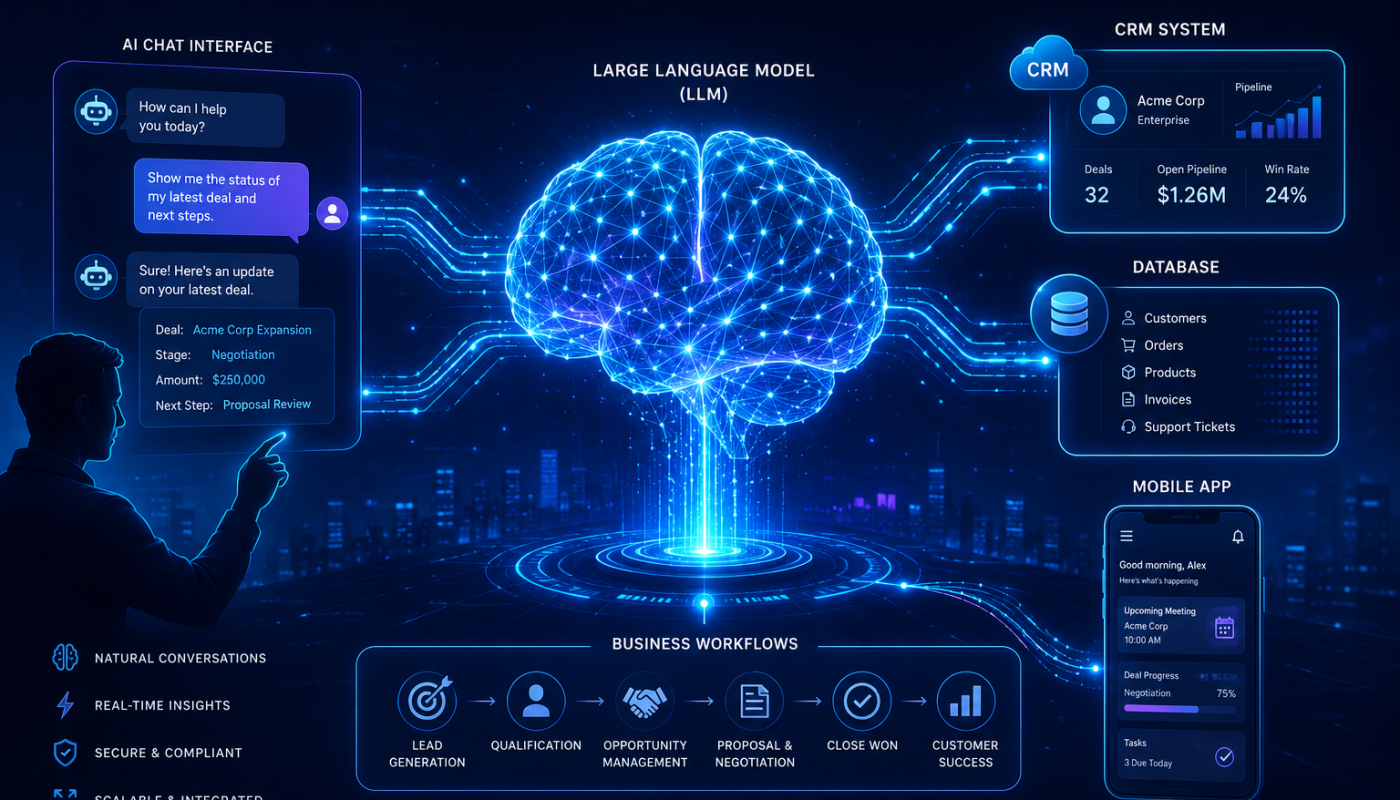
The true value of LLMs in a business context is unlocked when they are connected to live systems through APIs. A standalone LLM is knowledgeable but isolated; an LLM integrated via API into your CRM, ERP, database, or project management platform becomes a dynamic participant in real business processes. For example, an LLM connected to a CRM API can pull a customer’s purchase history, analyze their support tickets, and generate a personalized outreach email — all in seconds, without human intervention. These workflows can be orchestrated using tools like n8n, Zapier, or custom-built pipelines, chaining together API calls so that data flows seamlessly between your LLM and the software your business already depends on. The result is automation that doesn’t just speed things up, but genuinely reasons about the work it’s performing.
Chatbots as the Human Interface to Intelligent Workflows
Chatbots powered by LLMs serve as the conversational front door to these deeper automated workflows. Rather than requiring employees or customers to navigate complex interfaces or submit formal requests, a well-built chatbot lets users simply describe what they need in plain language — and the system figures out the rest. A customer service chatbot, for instance, might handle a return request by simultaneously checking order status via an e-commerce API, updating a record in the support system, and sending a confirmation email, all triggered by a single conversational exchange. Internally, the same architecture can power HR assistants that answer policy questions, IT bots that reset credentials, or operations tools that surface real-time inventory data. The chatbot layer abstracts away complexity, making powerful backend automation accessible to anyone in the organization, regardless of technical skill.
A Living System That Grows With Your Business
Perhaps the most compelling aspect of LLM-powered architectures is that they are inherently designed to evolve. As your business grows — adding new product lines, entering new markets, or restructuring teams — the underlying AI workflows can be updated by modifying prompts, connecting new APIs, or retraining models on fresh data, often without rebuilding core infrastructure. New capabilities can be added modularly: a logistics company might start with a customer-facing chatbot and later extend the same system to handle freight tracking, invoice reconciliation, and vendor communications. Over time, usage data and feedback loops allow the system to improve continuously, learning the specific language, priorities, and edge cases of your business. Rather than a static software deployment that becomes outdated, an integrated LLM ecosystem becomes a compounding asset — one that gets smarter, faster, and more valuable as your organization scales.
Visit aibizdr.com to learn more and schedule a consultation.

About AiBizDr
AiBizDr is a smart home business dedicated to creating seamless IoT experiences. With over 10 years of experience designing, installing, and securing intelligent residential systems, we’ve helped transform thousands of homes through smart, automated energy management.
With a background in digital design, marketing, and sales, Owner – Travis Danks has led and managed sales for top California home improvement contracting companies. He is also skilled in agentic AI, advanced prompting, and chatbot development—helping businesses implement AI-powered tools for automation, lead generation, and content creation.
Areas of Expertise:
High Efficiency Solar + Storage, EV Charging, Smart Panels, Roofing, HVAC, Water Heaters, Solar Pool Heating, Insulation, Windows, AI Automation, Chatbots, and Smart Home Integration.
Driven by a passion for innovation, AiBizDr focuses on bringing the future of smart homes and AI technology to life—today.